An ecological footprint can be defined as a rough estimate of one’s total environmental impact, through the use of transportation, energy sources, consumption of meat and processed foods, and more. Measuring my ecological footprint proved to be shocking, as my personal Earth overshoot was just April 11th. If everyone in the world lived this way we would need 3.6 Earths to sustain ourselves, and I consider myself environmentally conscious. According to environmentalists, the most developed countries use upwards of 70% of the Earth’s natural resources despite being home to only 17% of the world’s population. The United States alone is using an estimated 30% of these resources. The excessive consumption of both renewable and nonrenewable resources in wealthy countries has led to pollution of the air and water, as well as extreme weather and rising ocean levels. But it will not be just the environmentally non-conscious nations that will be affected; once the world’s ecosystems are irreversibly damaged no nation will escape its downfall. We are often given the narrative that we need to save the Earth, that the Earth is dying, but it is not the Earth that’s in danger of extinction. Earth has survived for 4.5 billion years and will survive to repair itself from the destruction humans have caused. We are what is in danger of extinction. G. Tyler Miller and Scott E. Spoolman of Living in The Environment write “According to environmental ethicists, we have a responsibility to leave the planet’s life-support systems in a condition as good or better than what we inherited for future generations and for other species” (Miller and Spoolman, page 8). I agree with this point, if we are going to continue to populate the Earth we have a moral responsibility to ensure that it will be habitable for the next few hundreds or thousands of years. An alternate solution would be to cut back on population growth through intensive family planning organizations and the freedom for women globally to make reproductive decisions. An article from Bioscience titled “World Scientists’ Warning of a Climate Emergency” reads “These policies make family-planning services available to all people, remove barriers to their access and achieve full gender equity, including primary and secondary education as a global norm for all, especially girls and young women.” (BioScience, Volume 70, Issue 1, January 2020, Pages 8–12). Right now, about one fifth of the world is livign in absolute poverty, meaning they do not have enough to eat and another percent of those are facing malnutrition. Everyone deserves to have enough clean food and water regardless of age, gender, race, or income or what part of the world they are living in. A slow of population growth would decrease competion for the resources of food and clean water, and hopefully help with this issue.
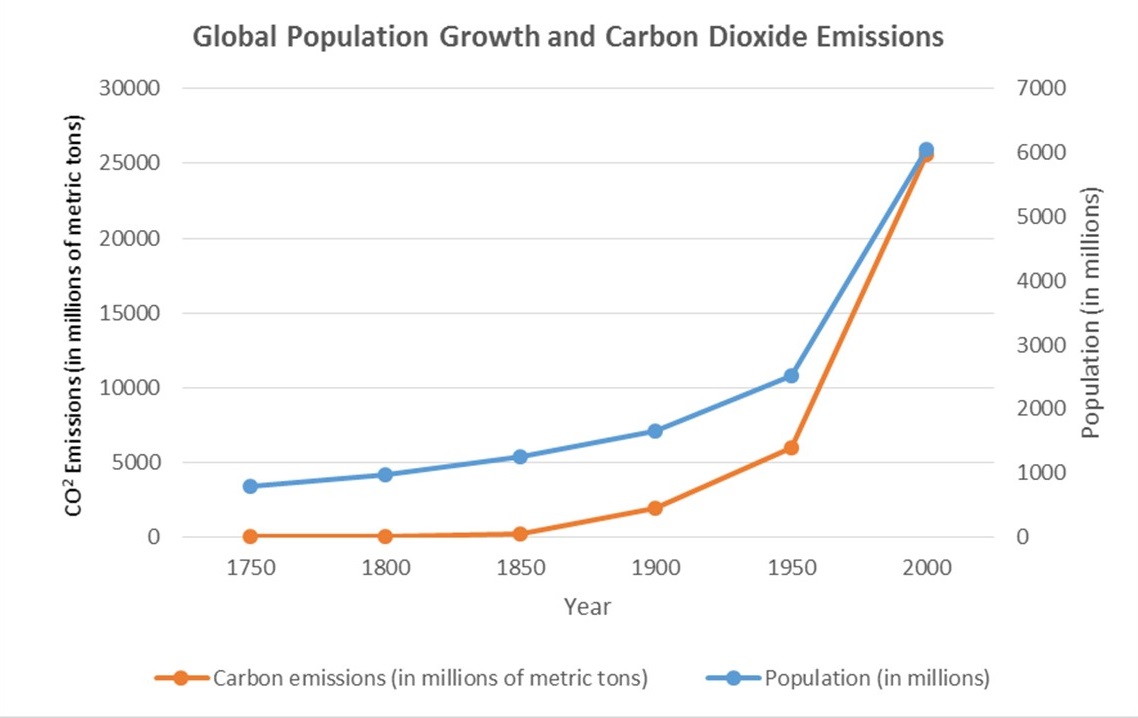
This graph depicts the metric tons of carbon emissions globally, and how they’ve increased with the population. In the United States, the average price per metric ton of CO2 was just $15.25.
What Can Be Done?
Although the human effects on the environment are evident and deeply troubling, some steps can be taken to reduce our ecological footprints, both personally and as a whole. Miller and Spoolman write “If the total ecological footprint is larger than its biocapacity, the area is said to have an ecological deficit. Such a deficit occurs when people are living unsustainably by depleting natural capital instead of living off the renewable resources and ecosystem services provided by such capital” (Miller and Spoolman, page 11). I found that the most interesting and likely most effective way for humans to cut back on nonrenewable resources such as oil and gas, as well as metallic mineral sources is to pool less of them into war and preparing for war. According to the World Scientists’ Warning to Humanity which was signed by 1700 scientists in 71 countries, about one trillion dollars worth of resources are dedicated to this. By promoting peace we are promoting a healthier planet that can provide for the generations to come. We can also make sure that we are protecting the Earth’s resources by recycling, driving less or carpooling to reduce greenhouse gases and eating sustainably farmed local foods.
Discussion Questions:
Is it the responsibility of more developed nations to reuce their ecological footprints and use of resources so that less developed countries can use what they need without having to worry about the environmental impact?
Word Count: 740
Works Cited:
Miller, G. Tyler and Scott Spoolman. Living in the Environment. Cengage Learning Asia Pte Ltd, 2021
World Scientists’ Warning to Humanity, Union of Concerned Scinetists (UCS), April 1997
Figure 1. : How does Population Growth impact Climate Change? Katie Luoma | November 1, 2016, https://populationeducation.org/how-does-population-growth-impact-climate-change/
BioScience, Volume 70, Issue 1, January 2020, Pages 8–12, 05 November 2019 https://doi.org/10.1093/biosci/biz088
 Environmental Studies Blog
Leave a comment